Electronic Circuit Breaker (ECB) Status Indicators #
Overview #
The OctoPlex DC Power Distribution (DCP) System provides intelligent monitoring, control, and protection of the vessel’s 24V DC electrical circuits through Electronic Circuit Breakers (ECBs).
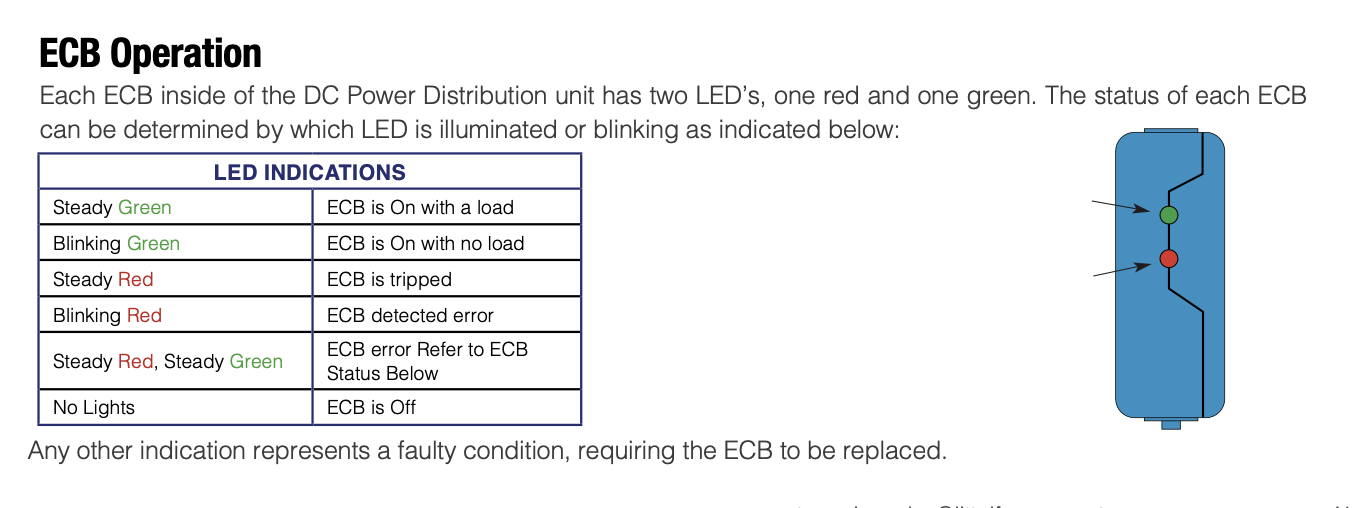
Each ECB within the DC Power Distribution Unit includes two status indicators:
- Green LED
- Red LED
The illuminated or flashing LED pattern provides valuable diagnostic information regarding the operating condition of each individual circuit.
This guide explains ECB status indications and provides basic troubleshooting steps for identifying common DC circuit issues.
ECB LED Status Indicators #
Each Electronic Circuit Breaker (ECB) communicates its operating condition through LED status indicators.
| LED Status | Condition | Description |
|---|---|---|
| Green LED ON | Normal Operation | ECB is powered and operating normally with the circuit available. |
| Green LED Flashing | Communication / Status Indication | ECB is communicating and functioning but may indicate a commanded or monitored state. |
| Red LED ON | Fault Condition | ECB has detected a fault condition or has opened the circuit for protection. |
| Red LED Flashing | Warning / Fault Indication | ECB has detected an abnormal operating condition requiring inspection. |
| No LED Illumination | Loss of Power or ECB Failure | Verify DC supply, connections, and ECB condition. |
| Red and Green LEDs Alternating | Diagnostic / Fault State | Review system status and investigate the associated circuit. |
LED behavior may vary depending on OctoPlex configuration and software version. Refer to vessel-specific documentation when available.
Understanding ECB Fault Conditions #
An ECB may activate protection due to:
- Electrical overload.
- Short circuit.
- Excessive current draw.
- Wiring faults.
- Connected equipment failure.
When a fault occurs, the ECB protects the vessel’s electrical system by disconnecting power to the affected circuit.
Troubleshooting an ECB Fault #
Step 1 – Identify the Affected Circuit #
Using the OctoPlex monitoring interface:
- Identify the circuit showing a fault.
- Confirm the associated equipment.
- Review any displayed alarms or status messages.
Step 2 – Inspect the Connected Load #
Before resetting the ECB:
Check for:
- Equipment malfunction.
- Damaged wiring.
- Loose connections.
- Water intrusion.
- Signs of overheating.
Correct any known issues before restoring power.
Step 3 – Reset the ECB #
After the fault source has been corrected:
- Command the circuit OFF.
- Allow the ECB to reset.
- Command the circuit ON.
- Confirm normal operation.
If the ECB immediately faults again, further troubleshooting is required.
No LED Indication #
If an ECB has no illuminated LEDs:
Verify:
- DC supply to the OctoPlex unit.
- Main DC input power.
- ECB seating and connection.
- Distribution unit operation.
A failed ECB or loss of supply power may result in no LED indication.
Preventative Maintenance #
To maintain reliable OctoPlex DC system operation:
- Monitor recurring ECB faults.
- Inspect electrical connections during routine service.
- Maintain accurate circuit labeling.
- Verify connected equipment remains within designed electrical loads.
- Keep OctoPlex software and system documentation current.
Important Notes #
Electronic Circuit Breakers provide both circuit protection and system monitoring. Repeated breaker trips should always be investigated rather than repeatedly reset.
Understanding ECB LED indications allows crew and technicians to quickly identify whether a problem originates from:
- The connected equipment.
- The wiring.
- The ECB.
- The OctoPlex control system.
This guide is intended as a supplemental Ocean Alexander Knowledge Base reference and does not replace official OctoPlex technical documentation or vessel-specific electrical procedures.
Need Assistance?
For technical support, warranty assistance, parts, or to schedule service:
Ocean Alexander Yacht Service
East Coast Yacht Group
2955 W State Road 84 Fort Lauderdale FL, 33312
954-530-2033
🌐
oayachtservice.com
Follow us for maintenance tips, technical updates, and service announcements:
Instagram
This article is part of the Ocean Alexander Yacht Service Knowledge Base. Information is provided for general guidance and should not replace the applicable Owner’s Manual or service procedures.
© Ocean Alexander Yacht Service – East Coast Yacht Group, Inc.


